Context: Why Pyralysis?#
Tip
Teaching or demoing the library? Start with the repository
README
section Flexible, composable, and extensible (short definitions + table + code)
and the Repository Examples page (*_components.py vs *_pipeline.py).
This page is the deeper motivation and architecture story.
Note
Why this matters: Pyralysis is designed to make radio astronomy imaging more accessible, flexible, and scalable for the next generation of telescopes and researchers.
The name Pyralysis is a fusion of two fundamental pillars of the project: Python and Radio Astronomy. As a software framework dedicated to advancing image synthesis, data reduction, and analysis in radio interferometry, it was essential for the name to capture both the computational and astronomical dimensions of the project.
Beyond this, Pyralysis also evokes paralysis, but in a metaphorical sense—representing the ability to “freeze” raw radio data, deconstruct it, and extract meaningful astronomical insights through structured, high-performance computational techniques. This is made possible by its object-oriented architecture, which provides the flexibility needed to accommodate evolving algorithms, optimize performance, and seamlessly integrate new methodologies for interferometric imaging and Faraday tomography.
At its core, Pyralysis embodies the synergy between flexibility, modularity, and scientific rigor, leveraging Python’s power to push the boundaries of radio interferometric data processing. By combining object-oriented principles with state-of-the-art computational techniques, it creates a robust and extensible platform for the next generation of radio astronomical research.
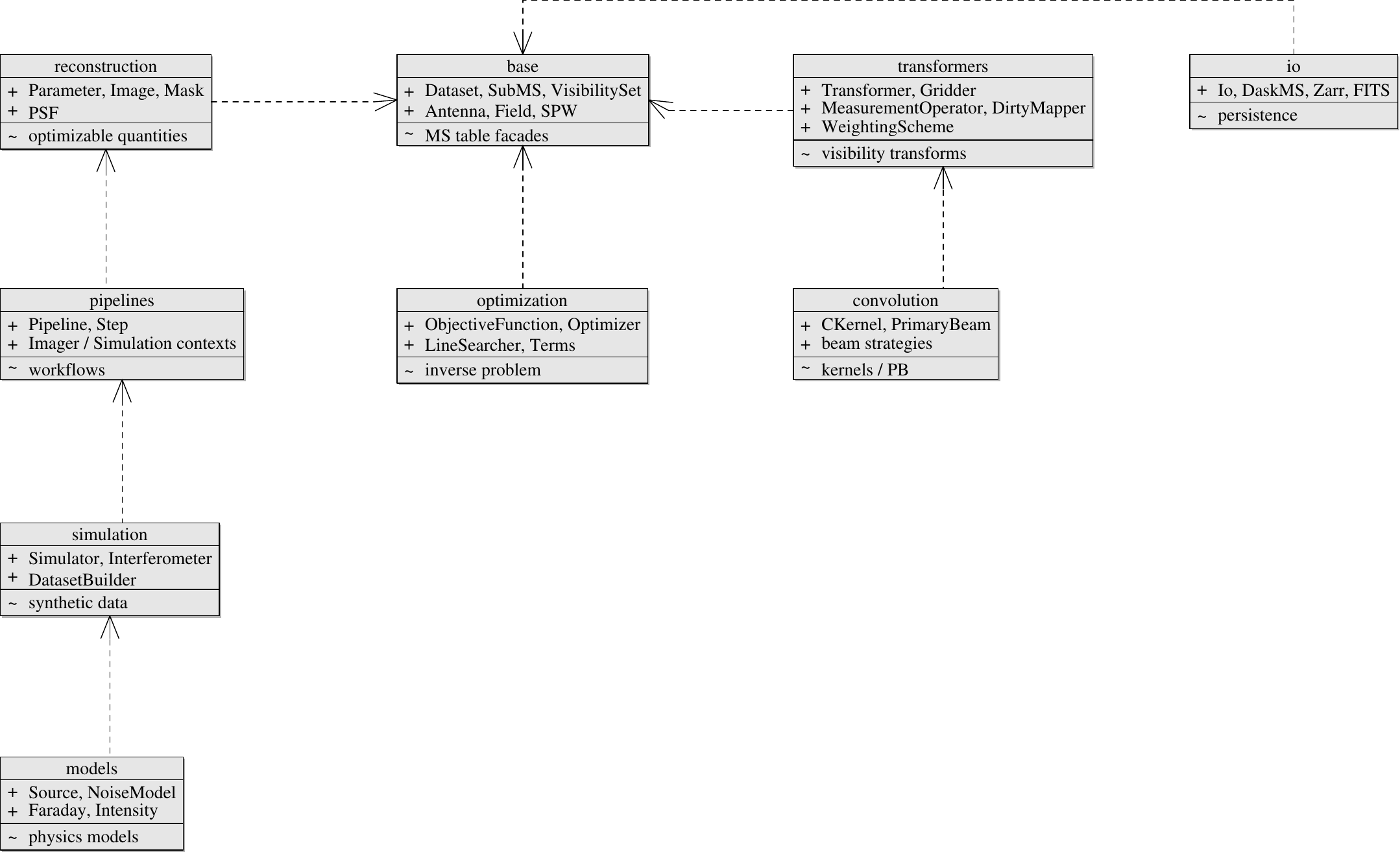
Subsystem overview of the main Pyralysis packages and dependencies.#
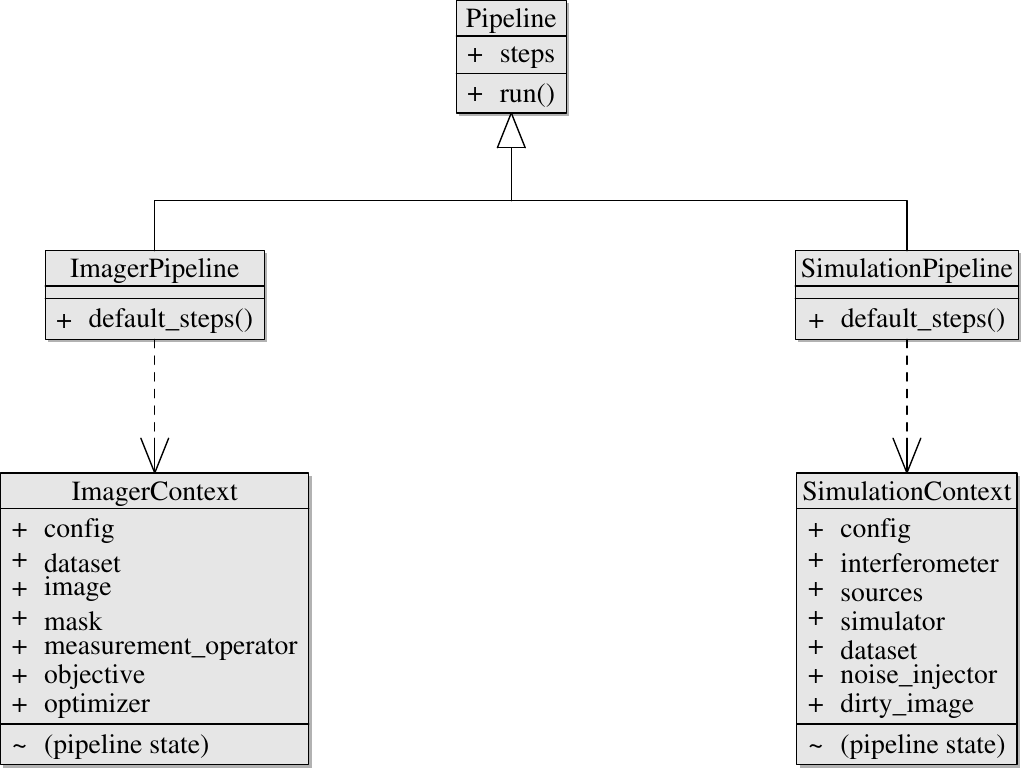
Pipelines and contexts (Pipeline, ImagerPipeline, SimulationPipeline, and context classes).#
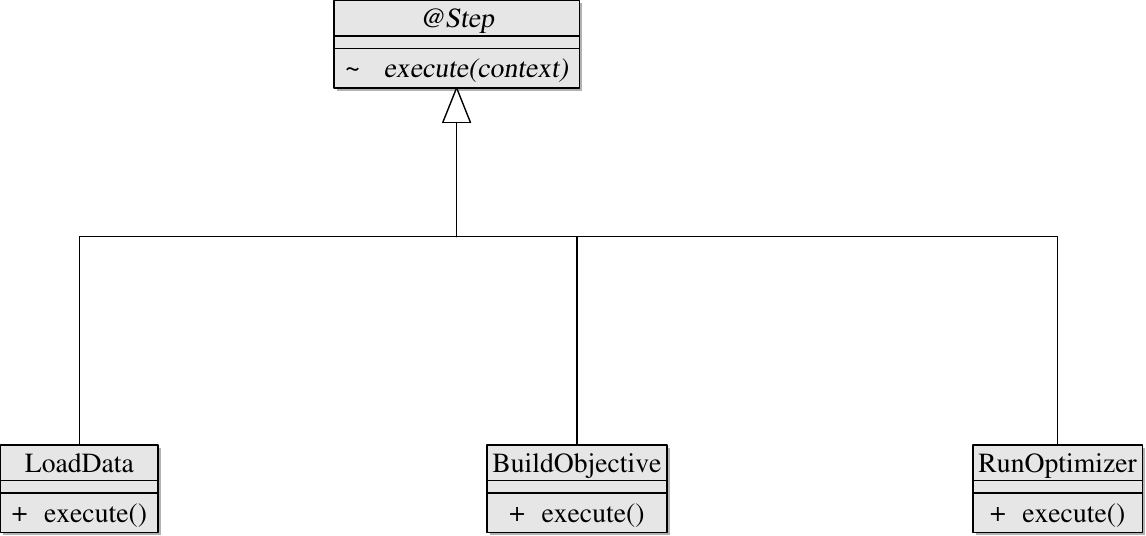
Step hierarchy (Step and concrete step implementations).#
—
Key Project Goals#
Make radio astronomy imaging software more accessible and modular.
Improve code readability and maintainability with modern software engineering.
Enable extensibility for new imaging techniques and workflows.
Be fully open-source and community-driven.
Scale to massive datasets with Dask, Zarr, and GPU acceleration.
—
Making Software More Accessible to the Community#
One of the main goals of Pyralysis is to make radio astronomy imaging software more accessible by:
Ensuring modularity – Pyralysis is built with an object-oriented design, making it easier for users to extend functionalities by adding custom classes, functions, and algorithms.
Improving readability – Unlike legacy software, Pyralysis follows modern software engineering practices to ensure that the codebase is well-structured, documented, and intuitive.
Enabling extensibility – Users can easily integrate new imaging techniques without modifying the core infrastructure.
These principles ensure that Pyralysis can be adopted by the community while remaining flexible for future developments.
—
Challenges in Existing Imaging Software#
While several radio interferometric imaging tools exist, they often present challenges in readability and maintainability:
Lack of structure – Many existing imaging software solutions are not object-oriented, making it difficult to follow the execution flow.
Scattered functions – Instead of organized class-based designs, they rely on functions spread throughout the code, which makes it harder to track dependencies and logic.
Lack of coding standards – Some tools do not follow modern software engineering practices, making it challenging to debug, modify, or extend functionalities.
Additionally, not all imaging software is open-source, meaning:
Limited transparency – If a codebase is closed, users cannot inspect or debug its inner workings.
Black-box behavior – Without access to the source, users must trust the software’s output without validation.
Pyralysis was designed to solve these issues by:
Being fully open-source – Allowing researchers to inspect, modify, and contribute to the code.
Following an object-oriented design – Making it easier to understand, modify, and extend.
Providing clear documentation – Ensuring users can quickly adapt and integrate new methods.
Having an object-oriented design also allows developers to design and implement software patterns, which helps keep the code organized, scalable, and reusable.
—
Beyond CLEAN: The Need for Mathematical Optimization#
Even though the radio astronomy community has explored advanced imaging techniques such as Regularized Maximum Likelihood (RML) methods and compressive sensing [Carrillo et al., 2014, Donoho, 2006, Wiaux et al., 2009], the dominant standard remains:
CLEAN – The most widely used imaging algorithm in radio astronomy [Högbom, 1974].
Multi-Scale CLEAN – A variant that models sources as a combination of point sources and Gaussians [Cornwell, 2008].
However, CLEAN is fundamentally a greedy algorithm rather than a mathematically-driven optimization method:
It iteratively subtracts bright sources from the visibility data.
It does not solve an inverse problem based on a proper image model.
It relies on heuristics rather than a well-defined cost function.
With the development of next-generation interferometers, the limitations of CLEAN are becoming more apparent, creating a need for more sophisticated imaging approaches.
—
Scaling for the Future: Big Data & Big Computing#
Upcoming and upgraded radio interferometers will produce massive datasets that traditional imaging pipelines cannot efficiently handle.
These include:
ALMA Sensitivity Upgrade – Higher sensitivity means larger, higher-resolution datasets.
Next-Generation VLA (ngVLA) – Producing petabyte-scale datasets that demand distributed computing.
Square Kilometre Array (SKA) – The largest radio interferometer, requiring exascale computing.
LOFAR and LOFAR 2.0 – Generating large low-frequency interferometric datasets.
To keep up with this scale of data, Pyralysis integrates big-data and big-computing techniques:
Dask – Enables parallel computing and out-of-core processing for large datasets.
Zarr – Efficiently stores and handles large-scale interferometric data.
Numba – Speeds up CPU-bound operations using Just-In-Time (JIT) compilation.
CuPy – Accelerates computations on GPUs while maintaining a NumPy-like API, making it easy to adopt for users familiar with NumPy.
By combining these high-performance computing techniques, Pyralysis can run gradient-based optimization algorithms that scale with modern radio astronomy datasets.
—
A Future-Proof Imaging Framework#
Pyralysis is not just another imaging pipeline—it is a flexible, scalable, and extensible framework designed to grow alongside the next generation of radio astronomy instruments.
It is built to:
Provide a mathematically solid alternative to CLEAN.
Leverage parallel and distributed computing for large-scale imaging.
Allow users to integrate custom models, algorithms, and workflows.
With these principles in mind, Pyralysis aims to become a community-driven solution for the future of radio interferometric imaging.
References#
Rafael E. Carrillo, Jason D. McEwen, and Yves Wiaux. Purify: a new approach to radio-interferometric imaging. Monthly Notices of the Royal Astronomical Society, 439(4):3591–3604, 2014. doi:10.1093/mnras/stu202.
T. J. Cornwell. Multiscale clean deconvolution of radio synthesis images. IEEE Journal of Selected Topics in Signal Processing, 2(5):793–801, 2008. doi:10.1109/JSTSP.2008.2006388.
David L. Donoho. Compressed sensing. IEEE Transactions on Information Theory, 52(4):1289–1306, 2006. doi:10.1109/TIT.2006.871582.
J. A. Högbom. Aperture synthesis with a non-regular distribution of interferometer baselines. Astronomy and Astrophysics Supplement Series, 15:417–426, 1974.
Yves Wiaux, Laurent Jacques, Gilles Puy, Anna M. M. Scaife, and Pierre Vandergheynst. Compressed sensing imaging techniques for radio interferometry. Monthly Notices of the Royal Astronomical Society, 395(3):1733–1742, 2009. doi:10.1111/j.1365-2966.2009.14665.x.
The Radio Interferometry Inverse Problem | Frequently Asked Questions (FAQ)