Flaggers: RFI detection and dataset integration#
This page documents the flagging subsystem in Pyralysis, including:
the flagging contract (
Flagger)threshold policies (
ThresholdPolicy)SumThreshold implementation (
SumThreshold)
Overview#
Flagger is the single entry point for both:
Array-level detection:
compute_mask()andapply().Dataset-level updates:
apply_dataset(), which walksDataset.ms_listand writes merged masks into each SubMSFLAGcolumn.
Concrete algorithms (e.g. SumThreshold)
subclass Flagger and implement
compute_mask() only; dataset
orchestration is inherited.
Architecture#
Flagger-compute_mask(data, **kwargs),apply(data, flags=..., **kwargs),apply_dataset(dataset, vis_key=...).ThresholdPolicy- Interface for computing thresholds from window size.SumThreshold- Multi-axis SumThreshold driver over visibility cubes.
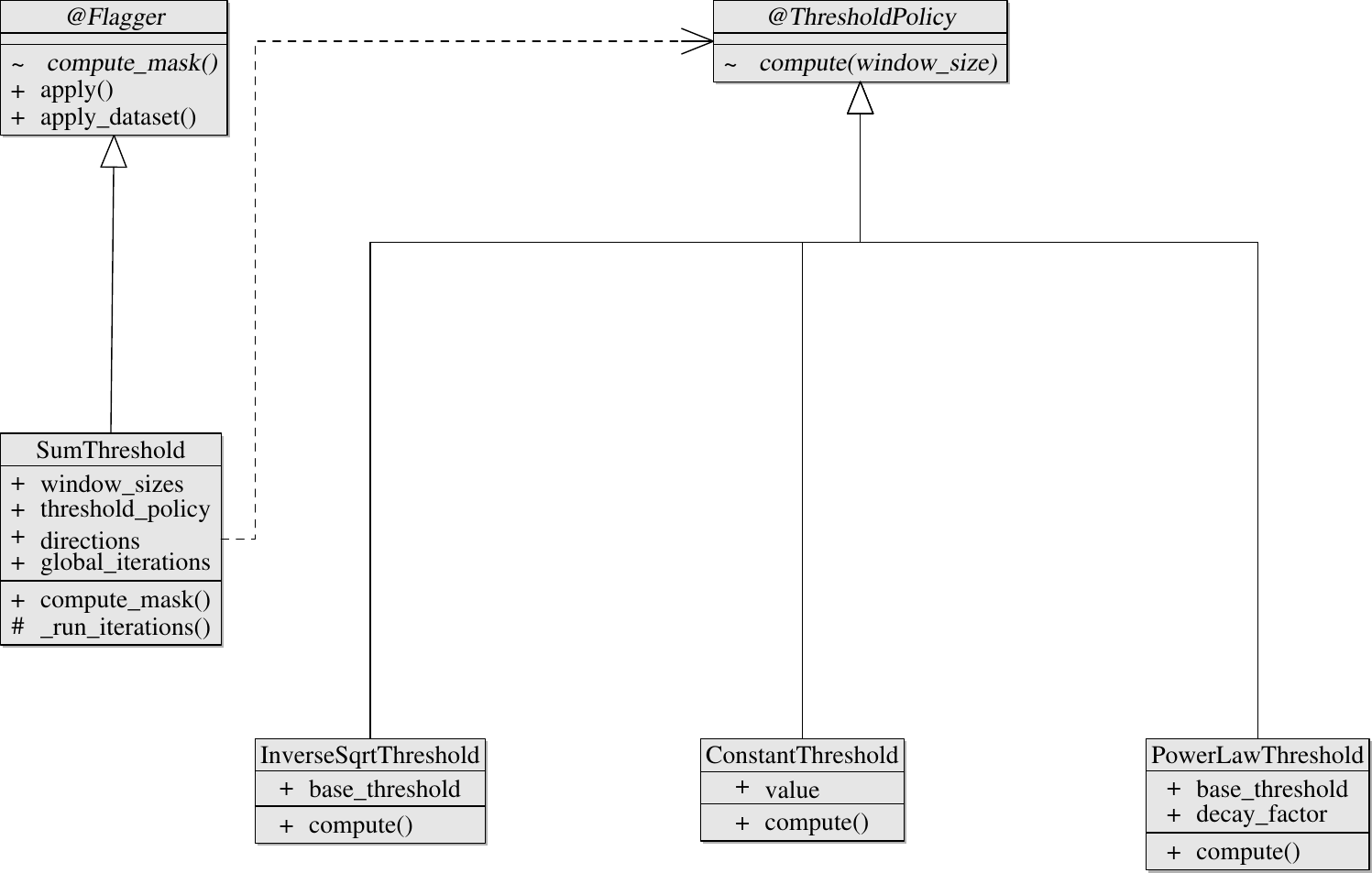
Flaggers UML (Flagger / SumThreshold / ThresholdPolicy).#
SumThreshold algorithm mapped to code#
At high level, SumThreshold does:
Reshape visibilities from
(row, chan, corr)to(time, baseline, chan, corr)using contiguous time blocks.For each configured direction (frequency/time), run 1D SumThreshold: - moving sums over windows - per-window average - threshold with
chi(window_size)- expand window detections to sample-level flagsOR the new detections into a cumulative mask.
Flatten mask back to input shape.
Relevant methods:
_reshape_to_4d()_run_iterations()
Threshold strategies#
The threshold strategy controls chi as a function of window_size:
ConstantThresholdInverseSqrtThresholdPowerLawThreshold
This uses the Strategy pattern so experiments can swap threshold behavior without changing the detector implementation.
Dataset-level usage#
Call apply_dataset() on any concrete
flagger:
from pyralysis.flaggers import SumThreshold
from pyralysis.flaggers.models import InverseSqrtThreshold

threshold_policy = InverseSqrtThreshold(base_threshold=0.5)
sum_threshold = SumThreshold(
    window_sizes=[1, 2, 4, 8, 16],
    threshold_policy=threshold_policy,
    directions=("freq", "time"),
    global_iterations=1,
)

dataset = sum_threshold.apply_dataset(dataset, vis_key="DATA")
vis_key options:
"DATA","MODEL_DATA","CORRECTED_DATA""ALL"for all*_DATAcolumnslist/tuple of specific visibility-like columns
NumPy and Dask behavior#
The computational core accepts NumPy arrays and Dask arrays.
Dask arrays keep lazy operations in the moving-sum and threshold pipeline.
Some control-flow checks (for time-block validation) use concrete NumPy arrays because they validate metadata assumptions before reshape.
Future extension#
A natural next step is a composite Flagger
subclass that chains multiple detectors in sequence.